Soya Oil Refining Agents and Additives: Process Matching from Degumming to Deodorization
Qi'e Grain and Oil Machinery Co., Ltd.
2026-10-11
Industry Guide
Qi'e Grain and Oil Machinery Co., Ltd. explains how degumming, neutralization, bleaching, deodorization, and winterization agents support soybean oil refining quality control.
Practical process guidance
Matching Refining Agents with Soybean Oil Quality Control
The quality of refined soybean oil depends not only on the equipment used, but also on how each refining agent or process aid is matched to the crude oil condition. Qi'e Grain and Oil Machinery Co., Ltd. provides soybean oil refining equipment and process-oriented technical support for evaluating degumming, neutralization, bleaching, deodorization, and optional winterization requirements.
Why Agent Selection Matters in Soya Oil Refining
Crude soybean oil may contain phospholipids, free fatty acids, pigments, waxes, trace metals, moisture, and volatile compounds. These impurities can influence flavor, color, clarity, oxidation stability, storage behavior, and the final suitability of the oil for food or industrial applications.
A practical refining plan should therefore connect the selected agent or process aid with measurable raw-oil characteristics, including acid value, phosphorus content, color, odor, clarity, and low-temperature stability. The appropriate choice also depends on separation performance, equipment conditions, analytical verification, and applicable food-safety and environmental requirements.
Process Matching from Degumming to Deodorization
| Refining stage |
Typical agent or process aid |
Primary quality-control objective |
| Degumming |
Water, dilute acid, or selected enzymes |
Hydrating or converting phospholipids so gums can be separated from the oil |
| Neutralization |
Alkali, typically sodium hydroxide |
Reducing free fatty acids and supporting the removal of associated impurities |
| Bleaching |
Bleaching earth or activated clay |
Adsorbing pigments, trace metals, and residual phosphatides before filtration |
| Deodorization |
Steam under vacuum; no chemical deodorizing agent is implied |
Stripping volatile odor and flavor compounds and remaining free fatty acids |
| Winterization |
Controlled cooling followed by filtration |
Removing waxes and high-melting-point components to improve low-temperature clarity |
1. Degumming agents
Water or dilute acid can hydrate phospholipids and help form a separate gum phase for removal. Enzymatic degumming may also be considered where the process objective calls for improved phospholipid conversion and separation.
Check: phosphorus reduction, gum separation, oil loss, and downstream neutralization performance.
2. Neutralization alkali
Sodium hydroxide reacts with free fatty acids to form soap, which can be separated through suitable centrifugation or filtration. This stage may also help remove some phosphatides, pigments, and trace metals.
Check: acid value, soap separation, neutral-oil loss, and the condition of the oil entering bleaching.
3. Bleaching adsorbents
Bleaching earth or activated clay adsorbs color pigments, trace metals, and residual phosphatides. The treated oil is then filtered to remove the spent adsorbent.
Check: color improvement, adsorbent filtration, oil retention, and oxidation protection during treatment.
4. Deodorization aids and conditions
Deodorization uses high-temperature steam distillation under vacuum to remove volatile compounds, undesirable odors, flavors, and remaining free fatty acids. The process is controlled through heat, vacuum, steam, and residence time rather than a conventional chemical additive.
Check: odor and flavor neutrality, free fatty acids, thermal exposure, and oil stability.
Optional Winterization for Low-Temperature Clarity
If the refined soybean oil must remain clear in cool storage or in cold-use applications, winterization may be added after the main refining stages. The oil is cooled to encourage waxes and other high-melting-point components to crystallize, and the solids are then removed through filtration. Whether this stage is needed should be determined by the intended application and low-temperature stability requirements.
A Practical Quality-Control Sequence
- Characterize the crude oil: review impurity profile, acid value, phosphorus content, color, odor, moisture, and any relevant storage or origin information.
- Match the treatment: select the suitable degumming approach, neutralization conditions, bleaching adsorbent, deodorization parameters, and optional winterization requirement.
- Verify separation: confirm that gums, soapstock, bleaching earth, and crystallized waxes are effectively removed by the available separation equipment.
- Conduct pilot testing: evaluate process performance before fixing operating conditions or scaling the treatment to continuous production.
- Test the refined oil: verify appearance, odor, acidity, clarity, storage stability, and other parameters required by the target market and applicable standards.
Process Aids Should Be Matched to Equipment Conditions
The same agent may perform differently when temperature, mixing, vacuum, residence time, filtration area, centrifugation, or oil characteristics change. For this reason, agent selection should not be separated from the design and operating conditions of the soybean oil refining line.
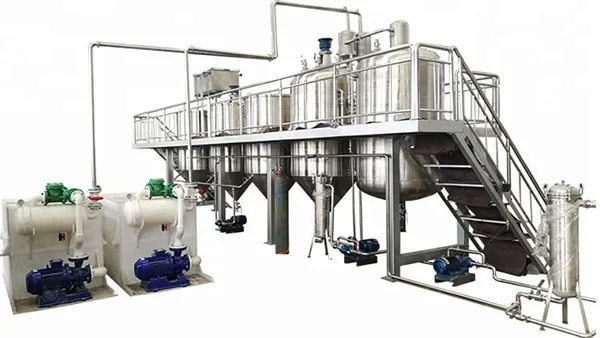
Qi'e Grain and Oil Machinery Co., Ltd. focuses on oil pressing equipment, oil production line equipment, and edible oil refining equipment. Its service scope can include process design, equipment selection, installation guidance, and technical support, helping B2B customers evaluate a refining configuration according to raw materials, production objectives, product quality requirements, and local operating conditions.
From Refining Stages to a More Consistent Product
Degumming, neutralization, bleaching, deodorization, and winterization each address a different quality concern. Correct process matching can support improved color, taste, odor, clarity, acidity control, and storage stability, while final filtration and packaging help protect the refined soybean oil after processing.
Important: agent type, dosage, temperature, reaction time, and separation conditions should be established through raw-oil analysis, pilot testing, equipment capability, and applicable food-safety and environmental requirements. Qi'e Grain and Oil Machinery Co., Ltd. can support customers in developing a practical soybean oil refining solution based on these process factors.


.png?x-oss-process=image/resize,h_100,m_lfit/format,webp)
.png?x-oss-process=image/resize,h_100,m_lfit/format,webp)
.png?x-oss-process=image/resize,h_100,m_lfit/format,webp)


.jpg?x-oss-process=image/resize,h_800,m_lfit/format,webp)
.jpg?x-oss-process=image/resize,h_800,m_lfit/format,webp)