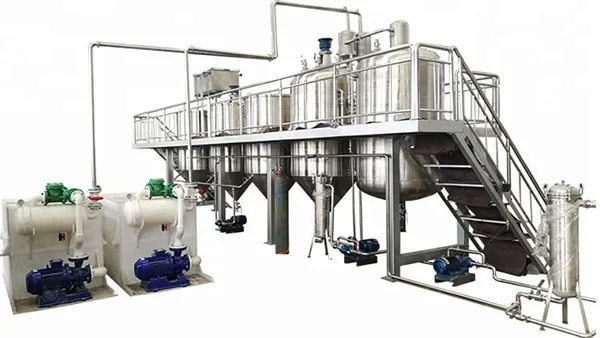
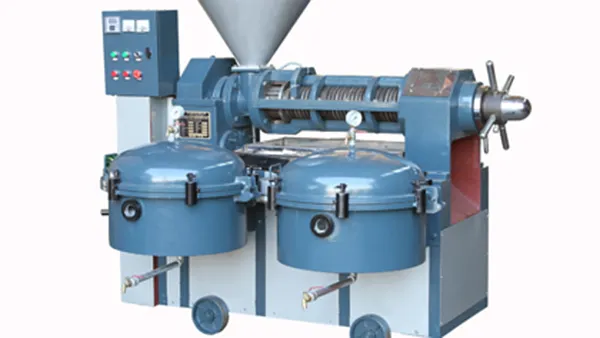
In the soybean oil refining process, the choice of degumming agents directly impacts the oil quality and subsequent process efficiency. Let's delve into the details to help you make better decisions.
Different degumming agents, such as phosphoric acid and citric acid, have their own applicable scenarios. Phosphoric acid is commonly used due to its strong ability to react with non - hydratable phospholipids. Generally, the recommended phosphoric acid addition amount is around 0.1% - 0.3% of the oil weight. This addition can significantly improve the phospholipid removal rate, which can reach up to 90% - 95% under proper conditions. Citric acid, on the other hand, is milder and is suitable for oils with relatively low impurity content. When using citric acid, the addition amount is usually about 0.05% - 0.15%.

To enhance degumming efficiency, temperature control is crucial. Pre - heating the oil to 60 - 70°C before adding the degumming agent can accelerate the reaction. Adjusting the hydration time also plays an important role. Usually, a hydration time of 20 - 30 minutes can ensure sufficient reaction between the degumming agent and phospholipids. In terms of reducing odor, matching the vacuum degree and steam flow is the key. A vacuum degree of 90 - 95 kPa and a steam flow of 1 - 2 kg/h per ton of oil can effectively remove odorous substances.
| Operation Parameter | Recommended Range |
|---|---|
| Pre - heating Temperature | 60 - 70°C |
| Hydration Time | 20 - 30 minutes |
| Vacuum Degree | 90 - 95 kPa |
| Steam Flow | 1 - 2 kg/h per ton of oil |
The modular design of the refining process can achieve seamless connection of the whole process of degumming - neutralization - bleaching - deodorization. This design reduces the loss in the intermediate links. For example, by using integrated equipment, the loss of oil during the transfer between different processes can be reduced from about 3% - 5% to less than 1%.

Let's look at a real - world case. A factory used to have an acid value of 2 - 3 mg KOH/g, a relatively dark color, and a strong odor in its soybean oil. After optimizing the degumming process with the methods mentioned above, the acid value dropped to 0.1 - 0.2 mg KOH/g, the color became lighter, and the odor was significantly reduced. The odor score increased from 3 points (on a scale of 1 - 10) to 8 points.
Flowcharts and parameter comparison tables can help you better understand the control points and collaborative relationships at each stage. For example, a flowchart can clearly show the sequence of each step in the degumming process, and a parameter comparison table can highlight the differences between different operation parameters and their impacts on the final oil quality.

If you are looking for a reliable partner to optimize your soybean oil refining process, QIE Group is your best choice. Our integrated refining equipment and professional technical services can help you solve production pain points, improve product quality, and enhance your market competitiveness. Click here to learn more about QIE Group refining solutions!
 Soybean oil refining equipment
Energy - saving technology
Modular design
Food safety certification
Green transformation
soybean oil refining equipment
modular design technology
installation cost reduction
energy-efficient refining equipment
grain and oil processing plant
soybean oil refining equipment
food safety certification
energy-efficient oil processing
modular refinery design
grain and oil processing plants
soybean oil refining process
degumming equipment for edible oil
deodorization odor control
small oil plant optimization
emission compliance in food processing
Soybean oil degumming and deodorizing technology
Refining equipment optimization
Edible oil quality improvement
Deodorization process parameters
One - stop oil refining
Soybean oil refining equipment
Energy - saving technology
Modular design
Food safety certification
Green transformation
soybean oil refining equipment
modular design technology
installation cost reduction
energy-efficient refining equipment
grain and oil processing plant
soybean oil refining equipment
food safety certification
energy-efficient oil processing
modular refinery design
grain and oil processing plants
soybean oil refining process
degumming equipment for edible oil
deodorization odor control
small oil plant optimization
emission compliance in food processing
Soybean oil degumming and deodorizing technology
Refining equipment optimization
Edible oil quality improvement
Deodorization process parameters
One - stop oil refining




.png?x-oss-process=image/resize,h_100,m_lfit/format,webp)
.png?x-oss-process=image/resize,h_100,m_lfit/format,webp)
.png?x-oss-process=image/resize,h_100,m_lfit/format,webp)

.jpg?x-oss-process=image/resize,h_800,m_lfit/format,webp)
.jpg?x-oss-process=image/resize,h_800,m_lfit/format,webp)