Guide to Selecting Agents and Aids for Soybean Oil Refining
Qi'e Grain and Oil Machinery Co., Ltd.
2026-10-12
Industry Guide
Qi'e Grain and Oil Machinery Co., Ltd. explains how to select refining agents and aids for soybean oil degumming, neutralization, bleaching, deodorization, and winterization, with practical quality control guidance.
Selecting the right refining agents and process aids is essential for producing stable, high-quality soybean oil. The choice depends on crude oil characteristics, impurity levels, target product quality, separation performance, and the design of the soybean oil refining equipment.
Qi'e Grain and Oil Machinery Co., Ltd. provides soybean oil refining process solutions covering degumming, neutralization, bleaching, deodorization, and optional winterization. This guide explains the role of commonly used agents and aids, together with the main quality control points for refining technicians, quality teams, and soybean oil processing project evaluators.
How Refining Agents Support Soybean Oil Quality
Crude soybean oil may contain phospholipids, free fatty acids, pigments, trace metals, waxes, moisture, and volatile compounds. These substances can affect flavor, color, oxidation stability, storage performance, and suitability for food or industrial applications. Refining agents help convert these unwanted components into separable phases or adsorb them for removal.
Key Agents and Aids Used in Soybean Oil Refining
| Refining stage |
Common agent or aid |
Primary function |
Main control consideration |
| Degumming |
Water, dilute acid, or enzymes |
Hydrates or breaks down phospholipids so gums can be separated |
Phosphorus level, mixing, temperature, hydration, and separation efficiency |
| Neutralization |
Sodium hydroxide or other approved alkali |
Reacts with free fatty acids to form soap for removal |
Acid value, alkali concentration, reaction conditions, and oil loss |
| Bleaching |
Activated bleaching earth or activated clay |
Adsorbs pigments, trace metals, residual phosphatides, and other impurities |
Adsorbent activity, dosage, contact time, vacuum, and filtration |
| Deodorization |
Steam under vacuum |
Strips volatile odor and flavor compounds as well as residual free fatty acids |
Vacuum, steam distribution, temperature, residence time, and oxidation protection |
| Winterization |
Cooling and filtration aids where required |
Crystallizes and removes waxes or high-melting-point components |
Cooling profile, crystallization time, filtration, and low-temperature clarity |
Selecting Agents for Each Refining Step
1. Degumming Agents: Water, Acid, and Enzymes
Degumming removes phospholipids, commonly referred to as gums, from crude soybean oil. Water can hydrate a portion of the phospholipids, allowing the gums to form a separate phase. Dilute acid may be used when more difficult-to-hydrate phospholipids require conditioning before separation.
Enzymatic degumming uses selected enzymes to modify phospholipids and support their removal. It can be considered when the project requires improved phosphorus reduction or a different approach to oil and gum separation.
Quality focus: Check the crude oil’s phosphorus content, moisture, temperature, mixing performance, and residual phosphorus after separation. The most suitable method should be confirmed through feedstock testing and process trials.
2. Neutralization: Choosing and Controlling Alkali
Neutralization, also called alkali refining, removes free fatty acids from degummed soybean oil. Sodium hydroxide reacts with free fatty acids and forms soapstock, which can be separated from the oil through suitable centrifugal or filtration equipment.
Alkali selection and dosage should be based on the oil’s acid value and the desired reduction in free fatty acids. Excess alkali may increase neutral oil loss, while insufficient alkali can leave unacceptable acidity and affect subsequent refining stages.
Quality focus: Monitor acid value, alkali concentration, reaction temperature, mixing intensity, soap separation, and oil entrainment in the soap phase.
3. Bleaching Earth for Color and Impurity Removal
Activated bleaching earth or activated clay is used to adsorb color pigments such as chlorophyll and carotenoids. It may also help remove trace metals, residual phosphatides, and other substances that influence oil color and stability.
The performance of bleaching earth depends on its adsorption activity, particle characteristics, dosage, contact time, oil temperature, and vacuum conditions. The oil and adsorbent must then pass through an effective filtration system to remove spent earth.
Quality focus: Evaluate color reduction, residual phosphorus, soap traces, filtration clarity, oil loss, and the risk of oxidation during heating and handling.
4. Deodorization with Steam and Vacuum
Deodorization removes volatile compounds responsible for undesirable odors and flavors. It also reduces remaining free fatty acids through steam distillation under vacuum, producing soybean oil with a more neutral sensory profile.
Steam quality, vacuum stability, temperature control, residence time, and oil distribution are important to the deodorization result. The operating conditions should be selected according to the oil quality target and the design of the deodorizer.
Quality focus: Monitor odor, flavor, free fatty acids, moisture, color, oxidation indicators, heat exposure, and the efficiency of the vacuum system.
5. Optional Winterization for Low-Temperature Clarity
Winterization may be added when the refined soybean oil must remain clear during cool storage or cold applications. The oil is cooled under controlled conditions so waxes and other high-melting-point components crystallize and can be removed by filtration.
Quality focus: Control the cooling rate, crystallization time, filtration performance, and clarity of the finished oil at the intended storage temperature.
A Practical Selection Method for Refining Projects
- Analyze the crude soybean oil. Review free fatty acids, phosphorus, moisture, color, wax content, trace metals, and other relevant quality indicators.
- Define the finished oil target. Establish requirements for acidity, color, odor, flavor, clarity, storage stability, and intended application.
- Match the agent to the impurity. Use water, acid, or enzymes for degumming; alkali for neutralization; activated bleaching earth for adsorption; and steam under vacuum for deodorization.
- Confirm separation capability. Refining agents are effective only when the process equipment can provide suitable mixing, reaction, centrifugation, filtration, vacuum, heating, cooling, and steam distribution.
- Validate through testing. Compare process results, oil yield, agent consumption, residual impurities, operating conditions, and treatment of by-products before finalizing the process design.
Important Quality and Operating Considerations
- Agent dosage should be determined from laboratory analysis and process trials rather than applied as a fixed value to every crude oil.
- Poor mixing, unstable temperature, inadequate vacuum, or incomplete separation can reduce the benefit of a suitable refining agent.
- Excessive treatment may increase oil loss, energy consumption, adsorbent consumption, or unwanted changes in oil quality.
- Food-grade materials, chemical handling procedures, filtration standards, and local regulatory requirements should be considered during project planning.
- Final filtration, storage, and packaging conditions are also important for maintaining the quality achieved during refining.
Soybean Oil Refining Equipment and Technical Support
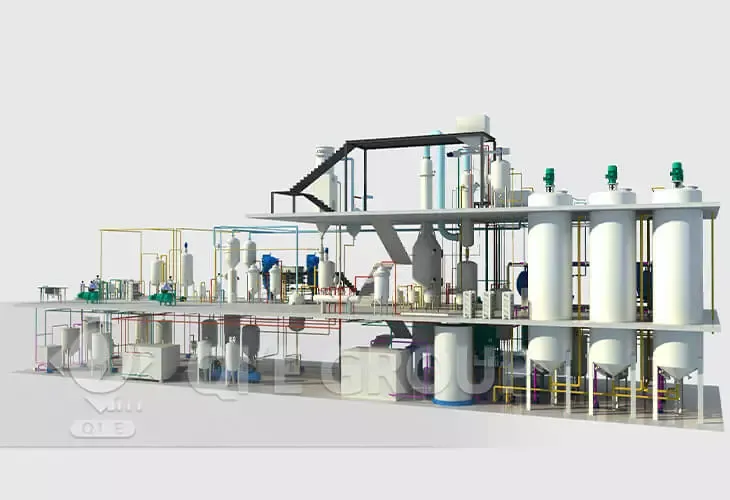
The selection of refining agents should be integrated with the complete process design. A soybean oil refining system may include degumming and neutralization units, bleaching equipment, filters, deodorization equipment, heat exchange systems, vacuum systems, and optional winterization facilities.
Qi'e Grain and Oil Machinery Co., Ltd. develops and supplies oil pressing equipment, oil production line equipment, and edible oil refining equipment for customers in Asia, Africa, South America, and other markets. Based on feedstock characteristics, production requirements, and finished oil targets, the company supports project evaluation, equipment selection, process design, installation, and technical service.
A reliable soybean oil refining process combines appropriate agents, controlled operating conditions, effective separation equipment, and consistent quality testing. The final selection should be tailored to the crude oil and the intended application of the refined soybean oil.


.png?x-oss-process=image/resize,h_100,m_lfit/format,webp)
.png?x-oss-process=image/resize,h_100,m_lfit/format,webp)
.png?x-oss-process=image/resize,h_100,m_lfit/format,webp)