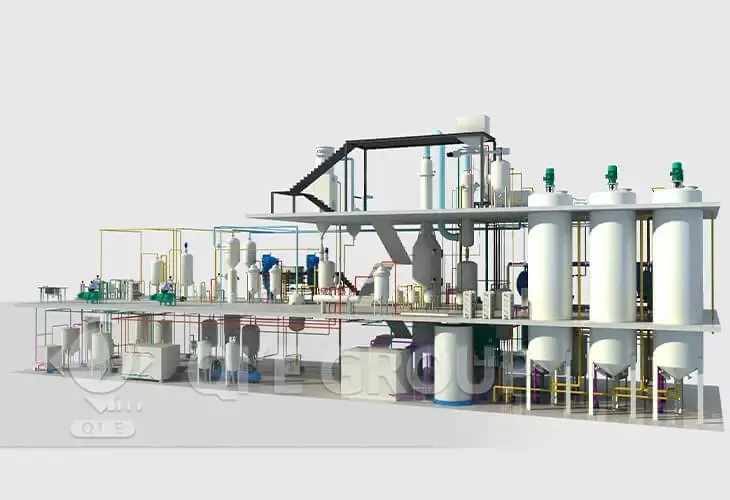
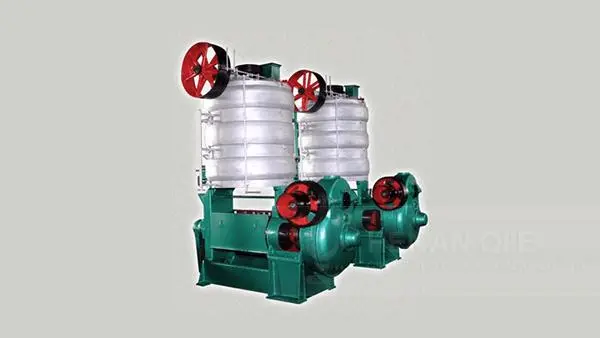
Qi'e Grain and Oil Machinery Co., Ltd. provides soybean oil processing equipment and technical solutions for solvent extraction projects. A stable soybean oil solvent extraction process requires more than a single extractor: cleaning, flaking, conditioning, extraction, mixed oil treatment, meal desolventizing, solvent recovery, crude oil filtration, and refining must operate as a coordinated system.
Solvent extraction is generally used for medium- and large-scale soybean oil production because it can recover oil from prepared soybean flakes and residual cake with high extraction efficiency. The actual performance of a plant depends on soybean quality, preparation conditions, equipment configuration, solvent management, temperature control, sealing, and operating procedures.
Cleaning, destoning, magnetic separation, crushing, flaking, and conditioning prepare the soybeans for effective oil release.
Prepared flakes are contacted with solvent in an extractor. The solvent dissolves the oil and produces a mixture commonly known as miscella or mixed oil.
The oil-bearing mixture is separated from the extracted soybean meal, and both streams are processed for solvent removal and further use.
Evaporation, stripping, condensation, and recovery equipment reduce solvent loss and support controlled, closed-loop operation.
Extraction performance is influenced by the coordination of upstream and downstream equipment. Qi'e Grain and Oil Machinery Co., Ltd. can support soybean oil processing projects with equipment planning for the following functional sections:
Stable soybean oil solvent extraction depends on maintaining suitable operating conditions throughout the process rather than optimizing one machine in isolation. Important control areas include:
| Control area | Why it matters | Operational focus |
|---|---|---|
| Material condition | Flake thickness, moisture, and temperature affect solvent contact and oil release. | Maintain consistent preparation and avoid excessive fines or damaged flakes. |
| Solvent circulation | Insufficient or unstable solvent contact can reduce extraction performance. | Monitor flow, distribution, concentration, and equipment sealing. |
| Temperature and residence time | These conditions influence evaporation, stripping, meal desolventizing, and energy use. | Use staged heating and maintain conditions suitable for the material and equipment design. |
| Sealing and vapor control | Effective sealing supports solvent recovery and safe plant operation. | Inspect seals, valves, condensers, ventilation, and safety interlocks. |
| Crude oil treatment | Fine particles and phospholipids can affect downstream refining. | Apply suitable filtration and integrate the extraction section with refining requirements. |
After extraction, the mixed oil contains extracted soybean oil and solvent. A properly coordinated evaporation and stripping section separates the solvent from the oil while preparing the crude oil for filtration and refining. The process should be designed around the required oil quality, heating method, vapor handling, and solvent recovery arrangement.
The extracted soybean meal also requires desolventizing before it is cooled, stored, or processed for feed applications. Controlled heat and residence time help remove residual solvent while protecting the intended quality of the meal. Equipment selection should consider throughput, moisture management, energy integration, and the operating conditions of the complete plant.
Process principle: solvent extraction, mixed oil treatment, meal desolventizing, and solvent recovery should be evaluated as one integrated system. Improvements in one section should not create instability in another.
Check soybean preparation, flake condition, solvent distribution, residence time, material loading, and possible channeling in the extractor.
Inspect equipment sealing, condenser performance, vapor balance, solvent recovery conditions, and possible leakage points.
Review desolventizer temperature, steam or heat distribution, residence time, material flow, and cooling conditions.
Examine raw material quality, filtration capacity, mixed oil separation, heating control, and compatibility with the refining section.
A suitable soybean oil processing equipment configuration should be based on the project’s intended capacity, soybean characteristics, desired oil and meal quality, utility conditions, available space, automation requirements, and local safety regulations. The extraction section should also be planned together with crude oil filtration and edible oil refining equipment.
With experience in oil pressing equipment, oil production line equipment, and oil refining equipment, Qi'e Grain and Oil Machinery Co., Ltd. supports B2B customers with process planning, equipment coordination, installation guidance, and technical service. Our approach is to match the soybean oil solvent extraction process with the customer’s raw materials, production objectives, site conditions, and downstream refining needs.
For a project assessment, the recommended starting information includes target capacity, soybean variety and quality, preferred extraction route, desired product specifications, available utilities, and the required level of automation. This information helps establish a practical and appropriately coordinated soybean oil processing solution.
 Qi'e Grain and Oil Machinery Co., Ltd. global soybean oil processing equipment trends industrial solvent extraction machine selection soybean oil production line integration oil recovery and lifecycle cost evaluation
Qi'e Grain and Oil Machinery Co., Ltd. soya oil refining agents degumming and bleaching agents deodorization additives soya oil quality control
Qi'e Grain and Oil Machinery Co., Ltd. edible oil production line equipment oil pressing equipment edible oil refining equipment oil processing flow
Qi'e Grain and Oil Machinery Co., Ltd. complete grain and oil processing equipment oil pressing equipment edible oil refining equipment oil production line configuration
soybean oil refining process edible oil refining equipment oil refining technology Qi'e Grain and Oil Machinery Co., Ltd. vegetable oil refining process